
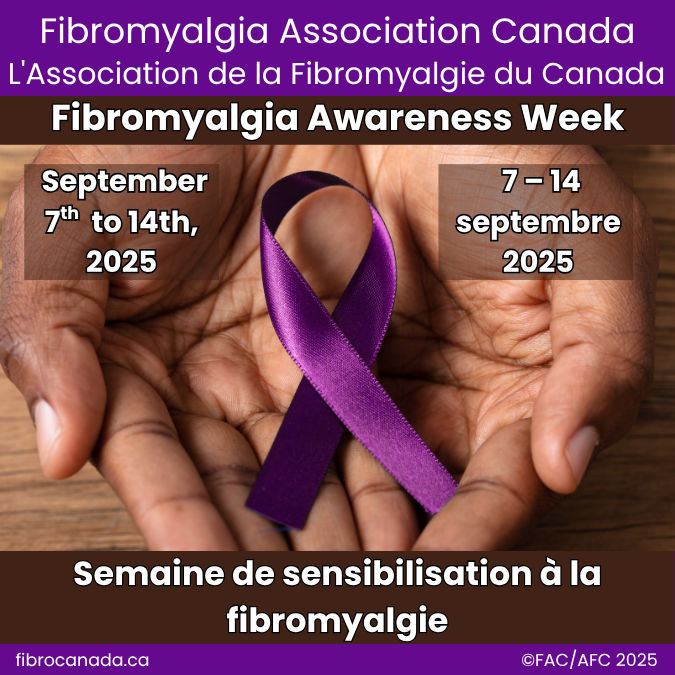
2025 Semaine de sensibilisation
La Semaine de sensibilisation n'est pas destinée aux personnes atteintes de fibromyalgie, mais à celles qui n'en souffrent pas, afin de les aider à comprendre ce que vivent les personnes atteintes de cette maladie. Cette semaine met en lumière la douleur chronique, la fatigue intense et les troubles cognitifs qui affectent notre fonctionnement quotidien, notre travail et notre qualité de vie.
Sensibiliser le public permet aux employeurs de reconnaître les efforts que représente le simple fait de se présenter au travail, aide nos familles et nos amis à comprendre qu'avoir l'air « bien » ne signifie pas que nous ne souffrons pas, et explique pourquoi les interactions sociales peuvent être épuisantes.
La Semaine de sensibilisation informe également les médecins, les chercheurs et les décideurs politiques sur la prévalence de la fibromyalgie et sur la nécessité de soutien, de recherche et de financement.
By speaking out and rai
Jour 1 - Trudy
Trudy Flynn, présidente de l’Association canadienne de la fibromyalgie (ACF), présente la Semaine de sensibilisation à la fibromyalgie et le thème « Nouveau départ en septembre », axé sur les soins personnels et l’autogestion. Tout au long de la semaine, les membres du conseil d’administration de l’ACF partageront leurs stratégies d’adaptation face à la fibromyalgie. Des annonces seront également faites, ainsi qu’une séance de soutien par les pairs (pleine conscience et Qi Gong) et une table ronde avec des professionnels de la santé.
Trudy partage ses stratégies personnelles pour gérer sa fibromyalgie, en insistant sur l'importance d'un sommeil régulier, d'une activité physique régulière (mais adaptée) et d'un état d'esprit positif. Elle souligne l'impact de l'alimentation et de l'évitement des allergènes, ainsi que la nécessité de se détendre et de gérer son stress pour prévenir les crises. Des activités comme la musique, les podcasts et le jardinage l'aident à se relaxer, mais elle insiste sur l'importance de doser ses efforts pour éviter le surmenage.
Globalement, son message encourage chacun à trouver ce qui lui convient le mieux, à privilégier les soins personnels et à adapter ses activités pour favoriser son bien-être.
Jour 2 - Sherry
Sherry, vice-présidente de l’Association canadienne de la fibromyalgie (ACF), explique comment elle gère sa fibromyalgie en adaptant ses soins personnels à deux phases : les crises et les jours où elle se sent mieux. Elle souligne que même les jours où elle se sent mieux, elle ressent une douleur de base et se concentre sur la prévention des crises.
Lors des crises, ses principales stratégies consistent à planifier à l'avance, à éviter de se surcharger, à dire non aux activités, à utiliser une trousse de soins personnels (comme des supports contre la migraine, des objets de réconfort et du repos), et — surtout — à demander de l'aide et à communiquer ses besoins.
Les jours où elle se sent mieux, elle continue de privilégier la planification, de fixer des limites (comme limiter les engagements en personne), de gérer son rythme et de décomposer les activités en étapes gérables. Elle intègre également de courtes séances d'exercice doux, qui contribuent à réduire la douleur au fil du temps.
Globalement, son approche met en lumière l'importance du rythme, de la flexibilité, de la bienveillance envers soi-même et de la mise en place de routines favorisant le bien-être physique et émotionnel.
Jour 3 - Mary
|
Mary, membre du conseil d'administration de l'Association canadienne de la fibromyalgie, explique que vivre avec la fibromyalgie a nécessité d'importants changements de mode de vie et une grande acceptation. Elle s'efforce d'adapter ses activités quotidiennes à ses limitations, en privilégiant les soins personnels et en planifiant à l'avance afin de réduire la fatigue.
Les stratégies clés consistent à se fixer des objectifs réalistes (« suffisamment bien » plutôt que la perfection), à gérer la surcharge sensorielle, à adapter son rythme d’activité et à se reposer au besoin. Elle utilise également des aides à la mobilité comme un siège de douche, une canne ou un déambulateur lorsque cela s’avère nécessaire. Globalement, son approche est axée sur l'acceptation, l'écoute de son corps et l'adaptation de son mode de vie pour maintenir l'équilibre et le bien-être. |
Jour 4 - Lina
Lina, membre du conseil d'administration de l'Association canadienne de la fibromyalgie, propose une approche holistique de la gestion de la fibromyalgie, axée sur le bien-être physique, mental et spirituel.
Sur le plan physique, Lina adapte son niveau d'activité en fonction de la saison et de son état au quotidien, en intégrant des étirements doux, des exercices simples et des activités quotidiennes comme le jardinage.
Sur le plan mental, elle gère le stress et l'anxiété en restant en contact avec les autres et en pratiquant des activités stimulantes, notamment en passant du temps dans la nature.
Sur le plan spirituel, elle trouve le plus grand soutien dans sa foi, sa communauté et le temps passé dans la nature, qui lui apportent paix, raison d'être et joie.
Globalement, son approche met l'accent sur la flexibilité, la conscience de soi et le développement de tous les aspects du bien-être.
Jour 5 - Janice
Janice Sumpton, de London (Ontario), partage son expérience de vie avec la fibromyalgie depuis 2005. Le diagnostic lui a permis de mieux comprendre la maladie, ce qui lui a donné les moyens de gérer ses symptômes et d'informer les autres, y compris le personnel médical.
Elle insiste sur l'importance de l'autoformation, du partage des connaissances et de la recherche d'informations fiables. Janice a adapté son mode de vie en renonçant aux activités physiques exigeantes et en découvrant de nouvelles stratégies d'adaptation, comme le tricot pour se détendre et se distraire de manière créative, les promenades en pleine nature et le maintien d'un rythme de sommeil régulier.
Son approche met l'accent sur le fait de rester curieux, d'explorer des activités agréables, de se ménager et de se reposer autant que nécessaire pour gérer le quotidien avec la fibromyalgie.
Jour 6 - Natasha
Natasha Flynn, membre du conseil d'administration de l'Association canadienne de la fibromyalgie, partage ses stratégies pour vivre avec la fibromyalgie. Sa principale méthode d'adaptation consiste en des exercices doux et adaptés à son rythme, comme la marche, la course fractionnée, la natation, l'utilisation d'un vélo elliptique et la musculation légère, qu'elle ajuste quotidiennement en fonction de son ressenti. Elle insiste sur l'importance de gérer son effort, de reconnaître ses limites et d'aborder chaque journée avec un état d'esprit positif.
Natasha souligne également l'importance de l'état d'esprit : rester positif, accepter que certains jours seront plus difficiles et utiliser la musique ou la télévision pour faciliter l'activité.
Un rythme social adapté et des efforts constants contribuent à prévenir les poussées et à maintenir l'énergie.
Globalement, elle s'attache à adapter ses activités, à rester active dans les limites de ses capacités et à conserver une attitude positive pour gérer sa fibromyalgie et profiter de la vie.
Jour 7 - Annonce du site web
Trudy, présidente de l’Association canadienne de la fibromyalgie (ACF), et Sherry, vice-présidente et développeuse web, ont profité de la Semaine de sensibilisation à la fibromyalgie pour annoncer le lancement du nouveau site web de l’ACF à l’adresse fibrocanada.ca.
Sherry a mis en avant les principales fonctionnalités : une page d’accueil repensée, une navigation facile, une option de traduction (français), une fonction de recherche, un menu avec des ressources organisées, les événements à venir et du contenu réservé aux membres comme des séances de soutien entre pairs.
Le site web comprend des ressources éducatives pour le public et les professionnels de la santé, des fiches d'information mises à jour, des résumés de recherche et une section FAQ.
Trudy et Sherry ont également expliqué comment les Canadiens peuvent adhérer gratuitement à la FAC, accéder aux avantages réservés aux membres et faire du bénévolat au sein de comités grâce à un processus d'intégration.
Trudy et Sherry ont insisté sur l'importance d'explorer le site, le nouveau kit de personnalisation (prochaine mise à jour) et la multitude de ressources disponibles. Elles ont conclu en félicitant l'équipe de développement web et en laissant entendre qu'une deuxième annonce importante serait faite prochainement.
Jour 8 - État des lieux et bilan de l'organisme caritatif
Trudy, présidente de l’Association canadienne de la fibromyalgie (ACF), a marqué la fin de la Semaine de sensibilisation à la fibromyalgie en soulignant que l’objectif de cette semaine est d’informer le public, les employeurs, les familles et les décideurs politiques sur les défis quotidiens liés à la fibromyalgie : la douleur chronique, la fatigue, le brouillard cérébral et les limitations sociales.
Sensibiliser le public permet d'améliorer la compréhension, les soins et la défense des droits.
Elle a souligné les réalisations de la FAC : le lancement du site Web remanié et convivial (fibrocanada.ca) et le nouveau statut d’organisme de bienfaisance de la FAC, permettant à l’organisation d’émettre des reçus fiscaux aux donateurs, d’étendre sa portée et de renforcer le soutien aux Canadiens atteints de fibromyalgie.
Trudy a également annoncé les prochains événements communautaires :
16 septembre : Première séance de soutien par les pairs/pleine conscience avec Lynne Hearte, instructrice de Qigong.
23 septembre : Table ronde avec Andrea Furlan (physiatre), Tyler Dillman (physiothérapeute) et Eleanor McGroaty (psychologue) sur l'autogestion de la fibromyalgie.
1er octobre : Discussion sur la fibromyalgie et l'autogestion avec Lynn Cooper et Trudy.
Oct 8: Presentation on insomnia and non-medication sleep strategies with David Gardner (Dalhousie University).
Trudy a encouragé les membres à s'inscrire via le nouveau site web, a remercié la communauté pour son engagement et a réaffirmé que FAC construit une communauté forte et solidaire pour les personnes atteintes de fibromyalgie.
 FR
FR  EN
EN