
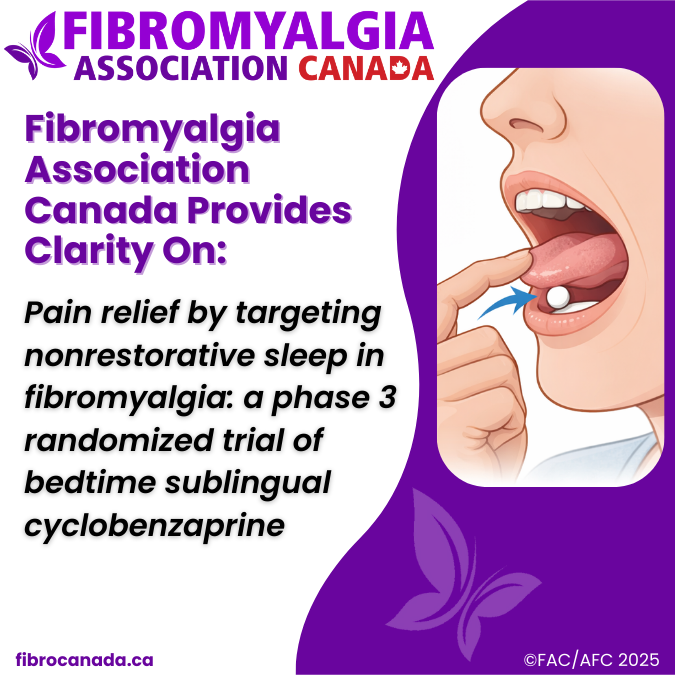
Sublingual Cyclobenzaprine Plain Language Summary
Title of Article
Pain relief by targeting nonrestorative sleep in fibromyalgia: a phase 3 randomized trial of bedtime sublingual cyclobenzaprine
Date of Publication 2025
Journal Citation https://doi.org/10.1093/pm/pnaf089
Background
Sleep disturbances are common in people with fibromyalgia and have been linked to increased pain, fatigue and difficulty thinking or concentrating. A drug that could improve sleep may also reduce pain, fatigue and “brain fog”. Cyclobenzaprine, a muscle relaxant, was initially studied in tablet form to improve sleep in people with fibromyalgia but was ultimately not approved for treating fibromyalgia due to not showing improvement in pain scores at 12 and 24 weeks. In tablet form it can remain in the body longer than needed, which may lead to side effects like daytime drowsiness or “brain fog.”
To improve this, researchers tested a new sublingual (under-the-tongue) version. Because it dissolves under the tongue, more of it is absorbed and it is absorbed faster. It works mainly during sleep, and results in lower drug levels during the day.
Who was studied
Participants were in the range of 18-65 years old with fibromyalgia (defined by the 2016 revised diagnostic criteria) from multiple centres across the United States.
The study excluded participants who were taking certain medications and certain conditions that could interfere with the results.
How was the study conducted
Participants were split into two groups and both participants and researchers did not know what treatment was assigned to them. Participants were in either the placebo group (sugar pill) or the drug group (sublingual cyclobenzaprine) with a dose of 2.8mg at bedtime for 2 weeks followed by 12 weeks of a 5.6 mg dose at bedtime. The study continued 2 weeks after the participants stopped taking both the placebo and the sublingual cyclobenzaprine to make sure there were not any delayed side effects.
Participants recorded pain intensity (0-10) and sleep quality (0-10) daily. In the clinic, participants completed questionnaires to assess the impact of the medication on their pain and sleep every 4 weeks.
Findings/Results
457 people started the study while 366 completed the study. Most participants self-reported a pain score of 5.9/10 at the start of study. Compared to the sugar pill, the sublingual cyclobenzaprine was significantly more effective in reducing pain and improving function scores and sleep diary scores. The majority of side effects were mild with severe side effects occurring in 0.9% of those receiving the cyclobenzaprine and 1.3% in those receiving the placebo. Side effects were responsible for participants leaving the study early in 6.1% of those on cyclobenzaprine and in 3.5% on placebo . Overall, 58.9% of cyclobenzaprine and 36.7% on placebo had at least one side effect. Local mouth side effects, such as tongue/mouth effects occurred in at least 2% of patients on cyclobenzaprine, with the majority of the issues resolving in less than 60 minutes. The most common other side effects were headache and sleepiness.
Limitations of Study
The participants were predominantly white female adults under 65 years, therefore findings may not generalize to other groups of people with fibromyalgia, such as children, men and people over 65. The patient-reported scores are subjective and may be variable. Long-term effectiveness and side effects beyond 14 weeks are needed.
Discussion / Conclusion
Sublingual cyclobenzaprine was more effective than sugar pills in reducing pain, improving sleep and functional questionnaire scores. The sublingual dosage form is unique and superior in effectiveness and side effects compared to the oral form of cyclobenzaprine. Side effects are most commonly local mouth effects.
Sublingual cyclobenzaprine is an example of effective therapy targeting disturbed sleep as an intervention.
This trial confirms the results of an earlier study in people with fibromyalgia.
FAC Research Committee Comments
An additional limitation is the study funding and oversight of the study was provided by the drug company that makes sublingual cyclobenzaprine which is potentially biased. Another limitation is that this drug was not tested with other medical conditions, or other drugs for drug interactions.
The Food and Drug Act (FDA) has approved this dosage form in the United States.
It is not currently available in Canada.
For more Fibromyalgia Association Canada Lay Summaries go here: https://fibrocanada.ca/en/research-highlights
 EN
EN  FR
FR